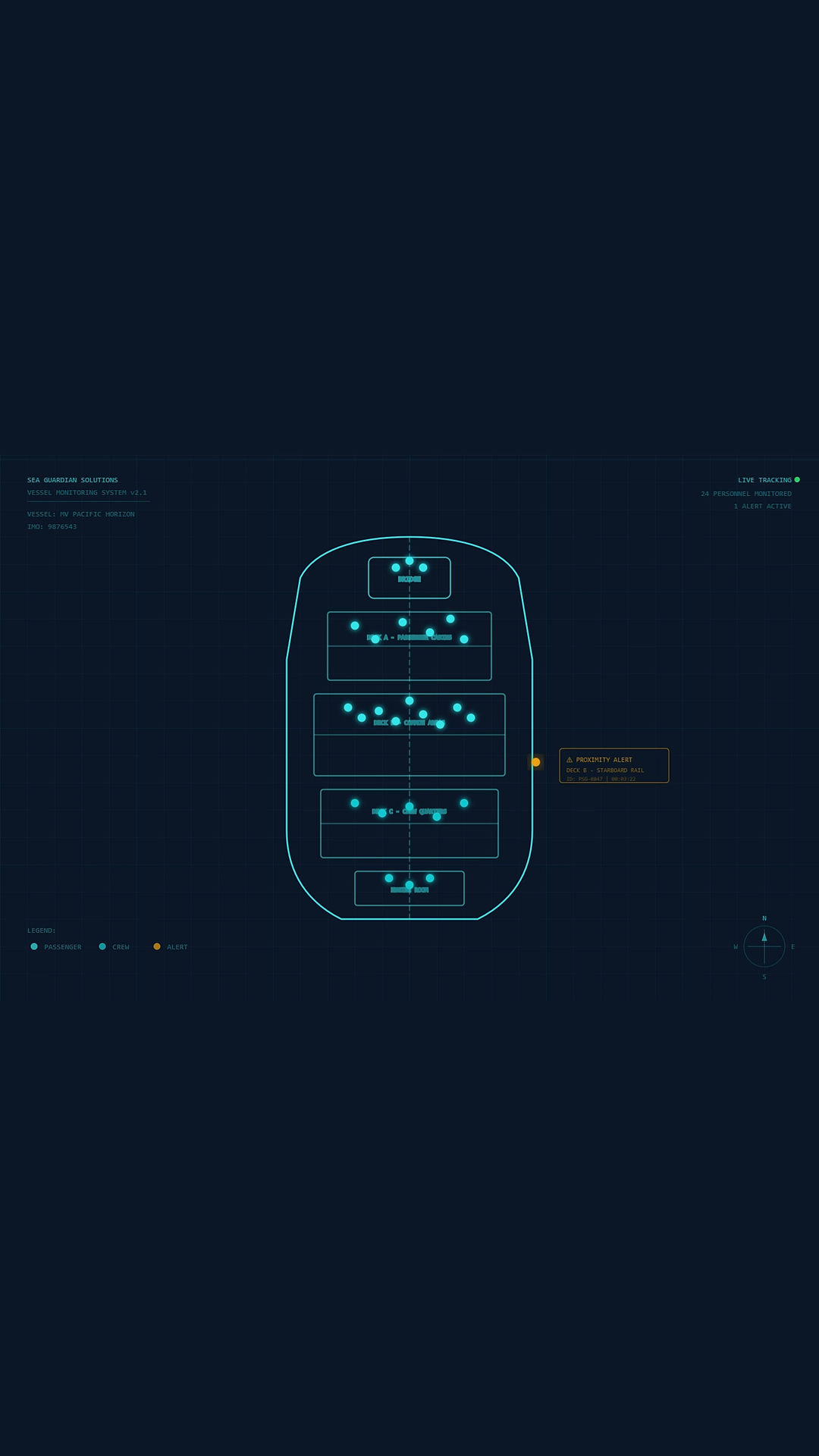

The Problem
"Every year, hundreds of people fall into the sea and are never seen again. In cold water, survival is measured in minutes, but on most vessels, detection still takes hours, if it happens at all. Man overboard incidents carry a 75% fatality rate, not because rescue is impossible, but because no one knew they were gone. Despite moving 80% of global trade across the world's oceans, the maritime industry still has no universal requirement to detect when someone goes overboard."
The Scale of the Problem
-
From 2015 to 2024, a total of 26,751 marine casualties and incidents were reported in EU waters, averaging 2,675 per year. SAFETY4SEA (EMSA 2025 Report)
-
Over that same decade, 609 lives were lost in 416 marine casualties. Worldports (EMSA 2025 Report)
-
There were 7,479 injuries from 6,534 marine casualties, and roughly 85% of the injured were crew members. SAFETY4SEA (EMSA 2025 Report)
-
78.8% of investigated marine casualties involved the human element, with 64.5% of accident events linked to human action and 50.5% of contributing factors related to human behavior. IIMS (EMSA 2025 Report)
Man Overboard, The Numbers
-
Several publications refer to an average of roughly 1,000 MOB deaths worldwide annually. maritime-executive (The Maritime Executive, citing industry publications)
-
In up to 75% of MOB cases, the person overboard dies. maritime-executive (The Maritime Executive)
-
Nineteen individuals fell overboard from cruise ships alone in 2024. Cruise Radio (CLIA, via Cruise Radio)
-
From 2000 to 2018, 284 people went overboard from cruise ships and 41 from large ferries, roughly two people per month. Wikipedia (Wikipedia, sourcing industry data)
-
The survival rate for overboard victims is estimated at only 17% to 25%. Perkins Law Offices (Multiple sources including CLIA data)
Commercial Fishing, Especially Severe
-
Falls overboard are the second-leading cause of death in commercial fishing, behind only vessel disasters. From 2000–2019, there were 266 deaths from falls overboard, and not a single victim was wearing a PFD. USCG (USCG Report of Investigation)
-
Drowning accounts for 82% of all commercial fishing fatalities in the Gulf of Mexico, with falls overboard as the number one incident type leading to death. USCG (USCG/NIOSH via CFID)
-
The fatality rate for commercial fishermen is approximately 75 per 100,000 workers — roughly 21 times higher than the average U.S. worker. USCG (Bureau of Labor Statistics / NIOSH, 2021)
The Detection Gap, Why Speed Matters
-
UK MAIB analysis found that crews have, on average, less than 11 minutes to recover someone who has fallen into cold water before they become unresponsive. Gard (Gard Insights / UK MAIB)
-
Cold shock occurs within the first 1–2 minutes of immersion, causing involuntary gasping and hyperventilation, if the head is underwater, the person drowns. Adventure Medical Kits (AMSEA)
-
After roughly 10 minutes, cold incapacitation sets in and a person loses the ability to meaningfully swim or grasp a rescue line. Adventure Medical Kits Summarized from Dr. Gordon Giesbrecht's "1-10-1 principle." (Widely cited in cold water safety literature)
-
Current IMO procedures like the Williamson turn work well only if someone notices the MOB immediately, even a few minutes of delay makes rescue problematic, and the difficulty multiplies at higher speeds or in darkness and bad weather. maritime-executive (The Maritime Executive)
The Regulatory Gap our System Fills
-
IMO safety procedures do not currently require any onboard systems or equipment to detect a MOB at the moment of falling, not even under the latest amendments to SOLAS Chapter III. maritime-executive (The Maritime Executive)
-
The majority of cruise ships do not have dedicated man-overboard detection sensors, and CCTV cameras are typically used as evidence after the event rather than for real-time monitoring. Emma Cruises (Emma Cruises / industry reporting)